Predictive. Generative. Autonomous. The Core Agent Types in Agentforce 360

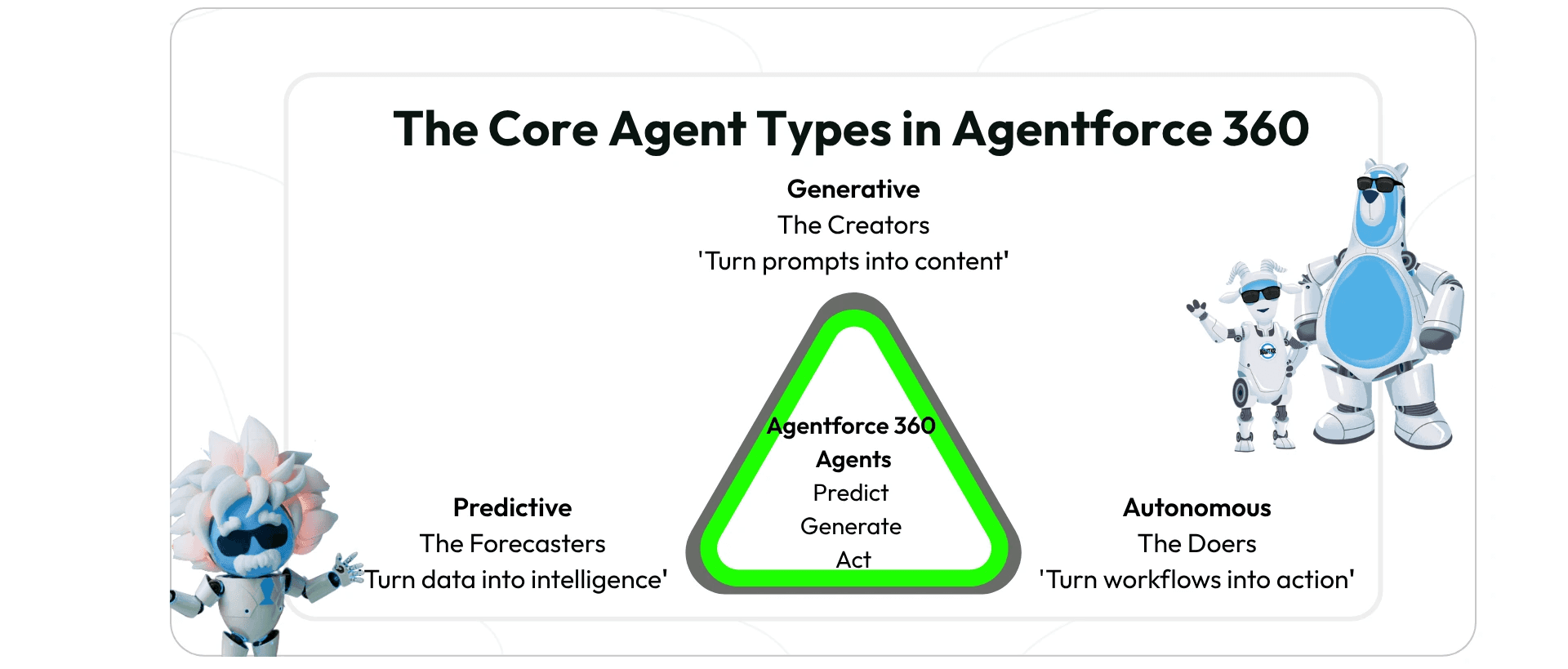
Agentforce 360 isn’t just about building “an AI assistant.” It’s about choosing the right type of agent for the right business outcome.
Let’s break them down.
1. Predictive Agents – The Forecasters
These agents analyze your CRM and Data360 to predict outcomes and recommend the best next steps.
How they work:
Learn from historical and real-time data.
Surface scores, risks, or action recommendations.
Examples:
Sales: Lead and opportunity scoring to prioritize the most promising prospects.
Marketing: Predicting churn risk so campaigns can proactively target at-risk customers.
Value: They turn raw data into actionable intelligence.
2. Generative Agents – The Creators
These agents use large language models (LLMs) to generate content and insights.
How they work:
Combine prompts with CRM data and knowledge articles.
Produce human-like, context-rich responses.
Examples:
Service: Auto-drafting case replies or knowledge articles.
Sales: Creating personalized outreach emails or summarizing meeting transcripts.
Value: They save time, boost consistency, and let humans focus on higher-value work.
3. Autonomous Agents – The Doers
These agents can take actions end-to-end with minimal human input.
How they work:
Execute workflows and processes.
Escalate only when complexity requires human intervention.
Examples:
Sales: An SDR agent that qualifies a lead, drafts an intro message, and books a meeting.
Service: An Employee Service Agent that resets passwords or updates employee records automatically.
Value: They drive efficiency at scale by reducing manual work.

Putting It All Together
In practice, many agents combine these capabilities.
For instance, an Account Management Agent might:
Predict which accounts are at risk,
Generate a personalized follow-up email, and
Autonomously schedule a check-in call.
That’s the real power of Agentforce 360: not just one type of agent, but a flexible system of Predictive, Generative, and Autonomous agents working together.
Final Thought
When designing your first agent, ask yourself:
Do I need it to predict something?
To generate something?
Or to autonomously do something?
Choosing the right type ensures a sharper scope, faster adoption, and better ROI.


Navin Aswani

Schedule a Free Salesforce Org Audit
Let’s review your tech stack, spot gaps, and show you how to scale better - starting now.
