The Architecture Behind an Agentforce Agent That Actually Works
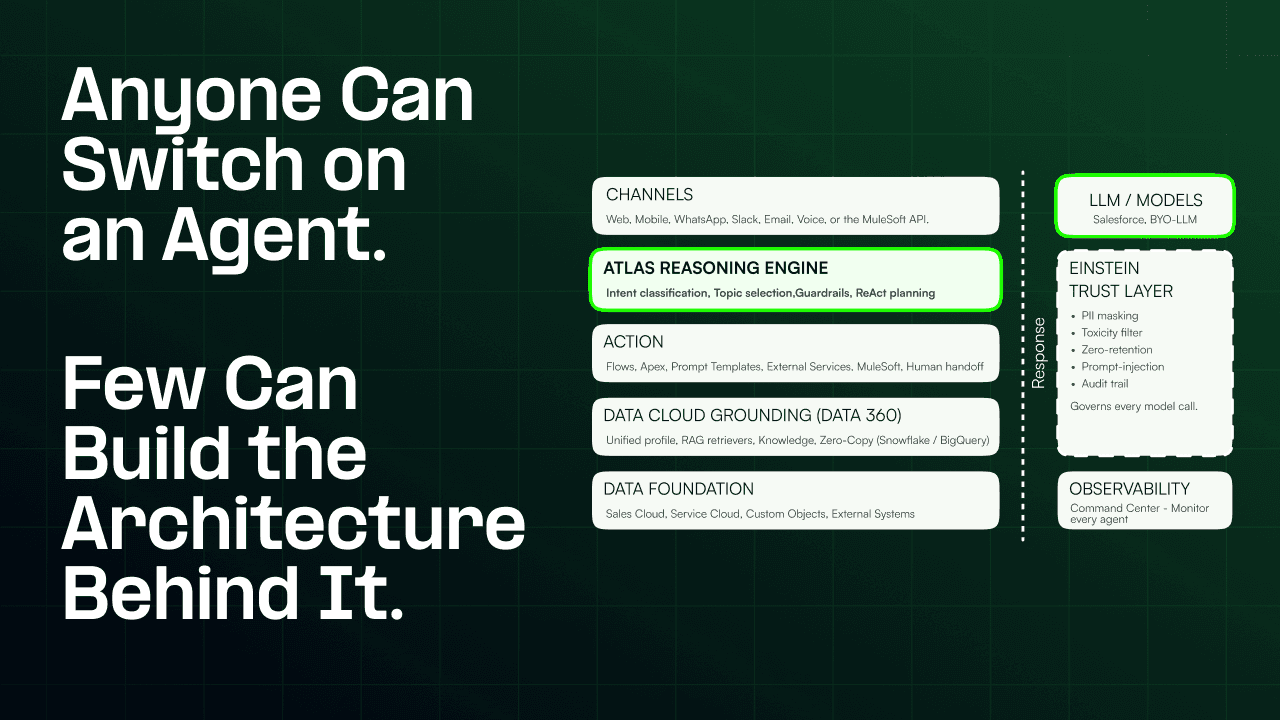
Anyone Can Switch on an Agent. Few Can Build the Architecture Behind It.
Agentforce makes standing up an agent look like a weekend project. The demo is three clicks and a smile. Production is a different sport entirely—and the thing that decides which one you end up with isn't the agent. It's the architecture underneath it.
An agent is a single layer. Below it sits a stack that reasons, acts, grounds itself in your data, and stays governed while it does — the difference between an assistant your customers trust and one your legal team finds out about later. Here's the whole thing, end to end.
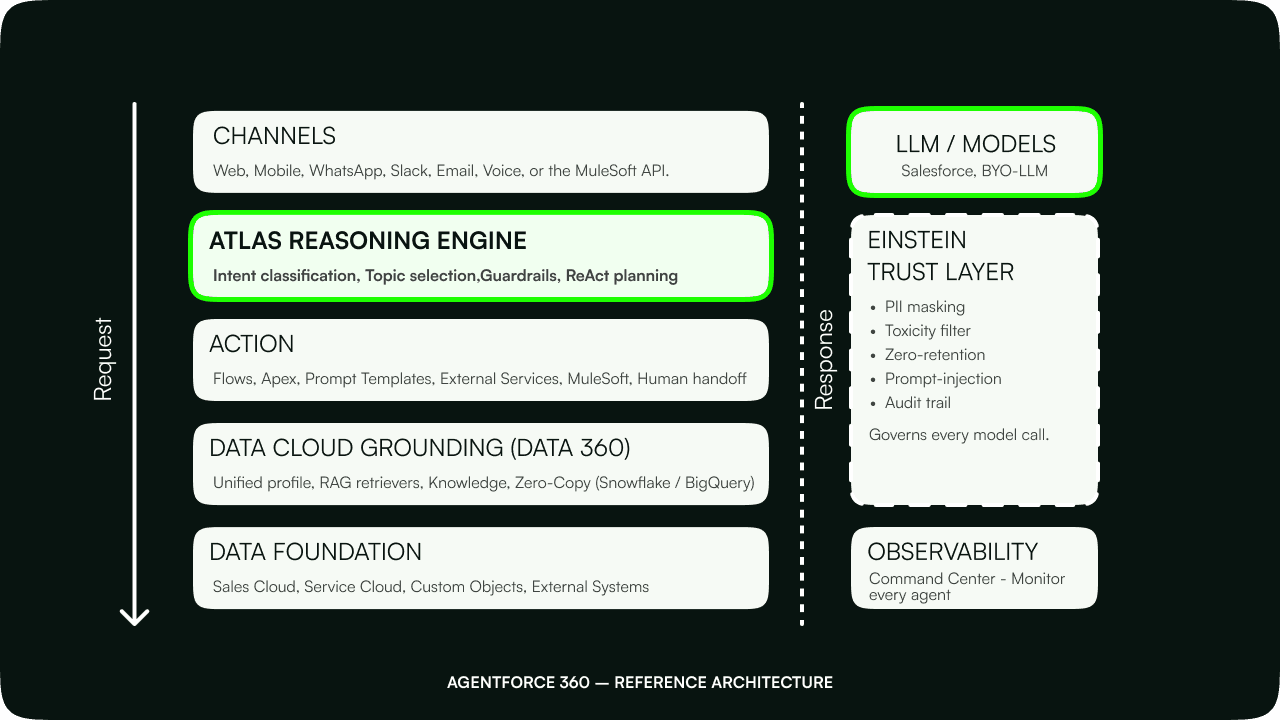
What You're Actually Standing Up
“Turn on an agent” quietly means turning on all of this. Each layer does a job, and each one is a place a project succeeds or stalls.
Channels: Where people meet the agent. Web, mobile, WhatsApp, Slack, email, and — now first-class — voice. One agent, many front doors, one consistent behaviour.
Atlas Reasoning: The brain. It reads intent, picks the right topic, follows your instructions and guardrails, and plans which actions to take. This is what makes an agent reason instead of just autocomplete.
Action: The hands. Flows, Apex, prompt templates, External Services, MuleSoft APIs — and a clean handoff to a human. This is where the agent actually does the work, safely and reversibly.
Data Cloud, Grounding: The memory. A unified customer profile plus RAG retrievers over your knowledge, connected by Zero-Copy to Snowflake or BigQuery. This is why answers cite your reality instead of guessing.
Data Foundation: The ground truth. Sales Cloud, Service Cloud, custom objects, and the external systems behind them. If this is messy, everything above inherits the mess.
Two things wrap the whole stack. The Einstein Trust Layer sits on every model call — masking PII, filtering toxicity, enforcing zero-retention, and logging an audit trail. Observability (the Command Center) watches every agent in production so you can see why it answered the way it did. Neither shows up in a demo. Both decide whether you can sleep after go-live.
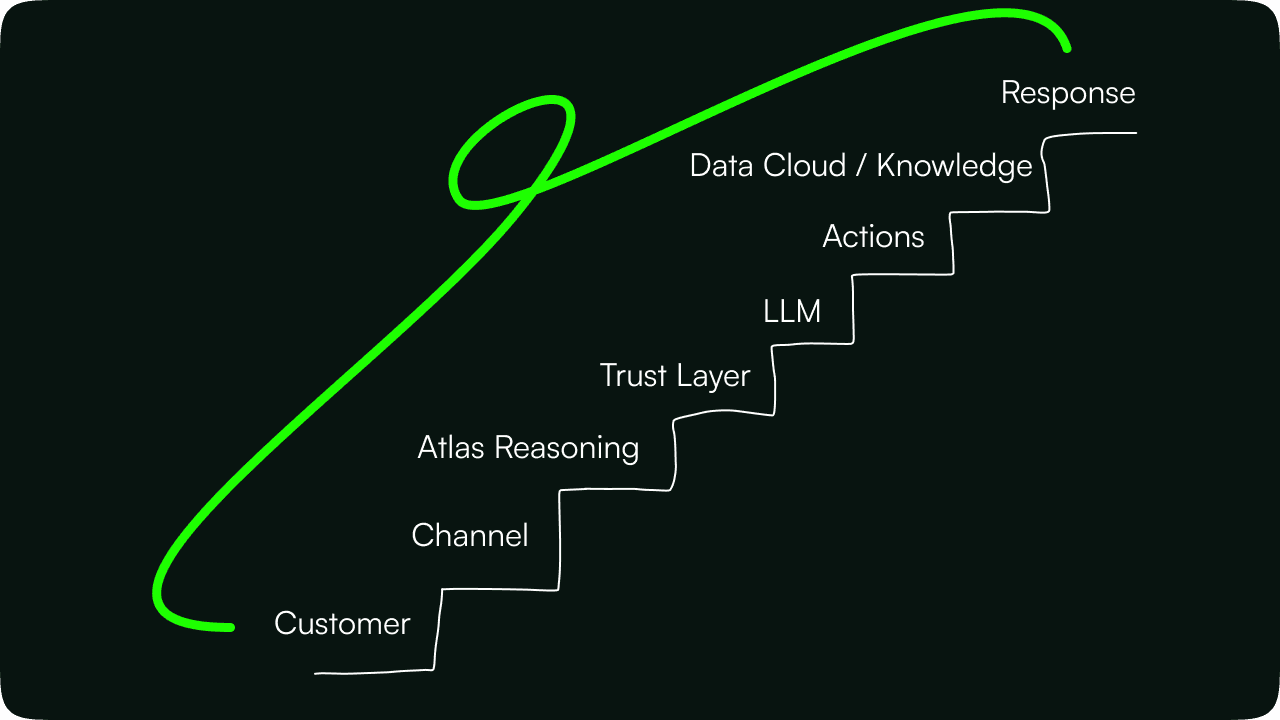
"The agent is one layer. The other five are where projects live or die."
The Demo Works. Production Doesn't. Here's Why.
We've been called into enough rescue projects to see the same failure pattern. It's almost never the agent. It's the architecture the agent was dropped onto.
Duplicate and stale records mean the agent trusts the wrong customer profile. Knowledge that was never turned into embeddings means it answers from generic training data, not your policies. Actions wired without guardrails mean it can do the wrong thing quickly. A Trust Layer left at defaults means PII you didn't intend to send, sent. No observability means you find out from a customer, not a dashboard. Each one is fixable — but only if someone owns the architecture, not just the agent.
CloudEarly Builds the Entire Stack, Not Just the Agent
We're a Salesforce partner that takes agents from proof-of-concept to production by getting every layer right. We unify and clean your data foundation, stand up Data Cloud grounding with real RAG retrievers, design actions in Flow, Apex, and MuleSoft, configure the Einstein Trust Layer to your compliance bar, and wire observability so the agent is measurable from day one, all against the Salesforce Well-Architected guidance, so what we build stays trusted, easy to change, and adaptable as you scale.
The result is an agent you can actually put in front of customers, grounded, governed, and observable, instead of a demo that never survives contact with real data.
Get a Free Agentforce Architecture Review
We'll map your current stack against the reference architecture above, show you exactly where an agent would break today, and hand you a prioritised plan to production. Thirty minutes, no slides-for-the-sake-of-slides. Book a call now!
Final Thought
Anyone can switch an agent on. The teams whose agents are still running in six months are the ones who built the architecture underneath it first.
The agent is the easy part, the architecture is the job.

Neha Nagori

Schedule a Free Salesforce Org Audit
Let’s review your tech stack, spot gaps, and show you how to scale better - starting now.
